

The Kinetic Theory of Gases: How Particles Behave

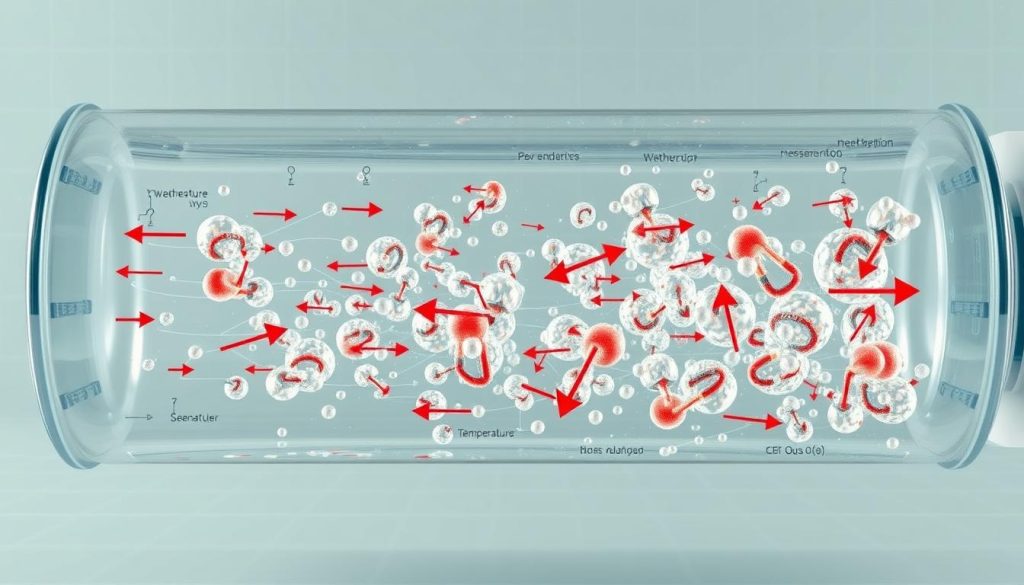
The kinetic theory of gases is a key idea in physics. It shows how gas particles move randomly and bump into each other and the container walls. This molecular motion is what makes gases behave the way they do, like their pressure and temperature.
This theory helps us understand how gases work by looking at their tiny particles. It shows how the big picture of gas behavior comes from the tiny actions of its particles.
The kinetic theory of gases is a powerful tool for explaining gas behavior. It covers everything from how gas particles collide to how fast they move. By learning about this theory, you can see how gas dynamics works and its uses in many areas, like gas viscosity and diffusion.
Introduction to the Kinetic Theory of Gases
The kinetic theory of gases explains how gas particles behave. It’s based on key assumptions and principles. These help us understand gases better.
Fundamental Concepts and Assumptions
The core of the kinetic theory includes several key points:
- Gas particles move randomly, going straight until they hit something else or the container’s wall.
- These particles are much smaller than the space between them. Their size is almost nothing compared to the gas’s volume.
- Gas particles bounce off each other in elastic collisions. This means they don’t lose any energy.
- The average kinetic energy of these particles depends on the gas’s temperature.
These assumptions help us understand how gas particles move and interact. This knowledge explains the properties we see in gases, like pressure, volume, and temperature.
| Key Assumption | Description |
|---|---|
| Random Motion | Gas particles are in constant random motion, moving in straight lines until they collide with other particles or container walls. |
| Negligible Volume | The volume occupied by the gas particles themselves is negligible compared to the total volume of the gas. |
| Elastic Collisions | Gas particles interact with each other through elastic collisions, with no net loss of kinetic energy. |
| Kinetic Energy and Temperature | The average kinetic energy of gas particles is directly proportional to the absolute temperature of the gas. |
Understanding these concepts and assumptions gives us insights into gases. This knowledge is useful in many fields, like thermodynamics and chemical engineering.
Properties of Gas Particles
The kinetic theory tells us that gas particles have unique properties. They are made up of atoms or molecules with specific mass and size. These particles move freely and collide with each other in an elastic way.
The interactions between gas particles depend on their size, mass, and charge characteristics. These factors greatly influence the gas’s behavior, like its pressure, temperature, and how fast molecules move.
| Gas Particle Property | Explanation |
|---|---|
| Mass | Each gas particle has a specific mass. This affects its energy and momentum when it collides with others. |
| Size | The size of gas particles affects how often and how they collide. This impacts the gas’s overall properties. |
| Charge | The charge of gas particles can cause extra interactions and forces. This can change how the gas behaves. |
| Interactions | The interactions between gas particles are mostly elastic. This means the total energy stays the same during collisions. |
Knowing the properties of gas particles helps scientists understand and predict gas behavior. This knowledge is key for progress in fields like thermodynamics, aerodynamics, and materials science.

Molecular Motion and Energy
The kinetic theory of gases explores how molecules move and their energy. Gas particles are always moving randomly. Each particle has its own kinetic energy. The total energy of the gas is the sum of all particles’ energies.
The average kinetic energy of gas particles relates to the absolute temperature. When the gas temperature goes up, so does the average energy of particles. This leads to more forceful collisions and higher pressure.
Kinetic Energy and Temperature
The link between kinetic energy and temperature is key in the kinetic theory of gases. The average kinetic energy of a gas particle is calculated by:
Average Kinetic Energy = (3/2) × k × T
Here, k is the Boltzmann constant and T is the gas’s absolute temperature. This shows that higher absolute temperature means more average kinetic energy. This results in more forceful collisions and higher pressure.
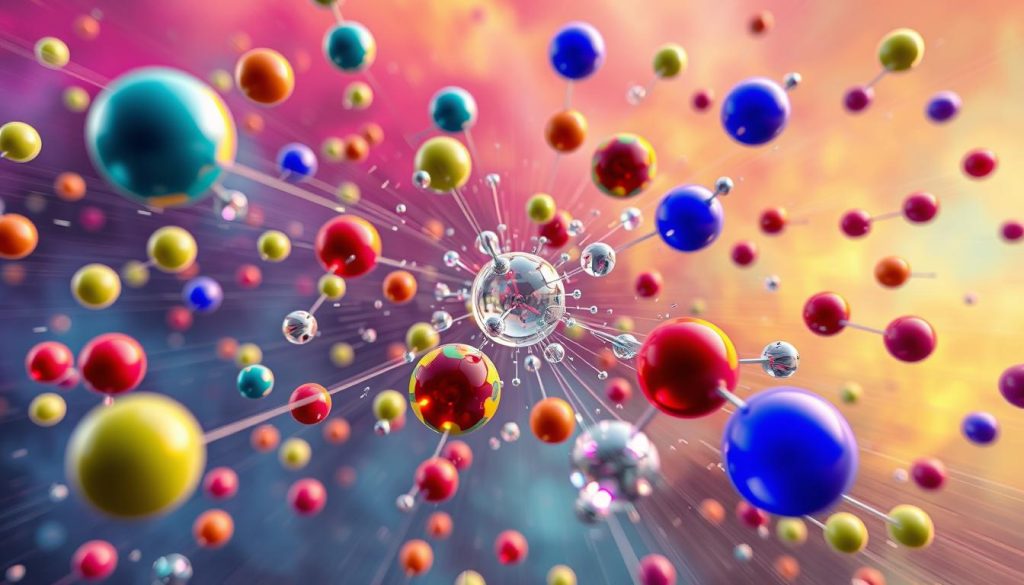
Understanding molecular motion and kinetic energy helps explain gas properties like pressure, volume, and temperature. These are the main topics of the kinetic theory of gases.
Kinetic Theory of Gases
The kinetic theory of gases helps us understand gases at a molecular level. It shows how the random motion and collisions of particles lead to gas properties like pressure and temperature. These properties are what we see and measure in gases.
At the core of this theory are a few main ideas:
- Gas particles move randomly and hit each other and the container walls.
- Their motion and collisions cause the pressure, temperature, and other gas properties.
- Changes in temperature and pressure change how gas particles move and interact.
This theory gives us insights into how gases behave and react to different conditions. It’s useful for understanding everyday gases and for creating new technologies that use gases.

The kinetic theory of gases is a key tool for studying matter and the physical world. It connects the tiny world of particles to the big world we see. This connection has made it a key part of physics and chemistry, with new discoveries always adding to our knowledge.
Gas Pressure and Temperature Relationship
The kinetic theory of gases explains how gas pressure and temperature are connected. This is shown in the ideal gas law. It says that gas pressure goes up with temperature and goes down with volume.
The ideal gas law comes from the kinetic theory. It shows how pressure, volume, and temperature are linked in an ideal gas. These laws and equations are key in science and engineering. They help predict and analyze gas behavior under different conditions.
 Physical Chemistry: Interaction Between Physics and Chemistry
 Ideal Gas Laws and Equations
The ideal gas laws give us math to understand gas pressure, temperature, and other gas properties. Some important ideal gas equations are:
- Boyle’s Law: The pressure of a gas goes down as its volume goes up, if the temperature stays the same.
- Charles’ Law: A gas’s volume goes up with its temperature, if the pressure stays the same.
- Combined Gas Law: This law combines Boyle’s and Charles’ laws. It shows how pressure, volume, and temperature of a gas are related.
These equations help us predict and analyze gas behavior. They are very useful in science and engineering, like in thermodynamics and aerospace engineering.
Understanding the basics of gas pressure, temperature, and other gas properties is key. The kinetic theory of gases gives us a strong way to study and control gas behavior in real life.
Elastic Collisions and Mean Free Path
In the kinetic theory of gases, gas particles behave through elastic collisions and the mean free path. These particles hit each other and the container walls. But, these hits are elastic, so there’s no energy loss.
The mean free path is how far a gas particle goes before hitting something else. It depends on the size and how many particles there are. This distance is key to understanding how gases move and spread out.
- Gas particles collide with each other and the container walls in an elastic manner, with no net loss of kinetic energy.
- The mean free path is the average distance a gas particle travels between successive collisions.
- The mean free path is inversely proportional to the size and number density of the gas particles.
- Understanding elastic collisions and mean free path is essential for accurately modeling and predicting the behavior of gases under various conditions.
The kinetic theory of gases helps us understand how gas particles interact. It’s based on elastic collisions and the mean free path. These ideas are vital for predicting gas behavior in many scientific and engineering fields.

Maxwell-Boltzmann Distribution
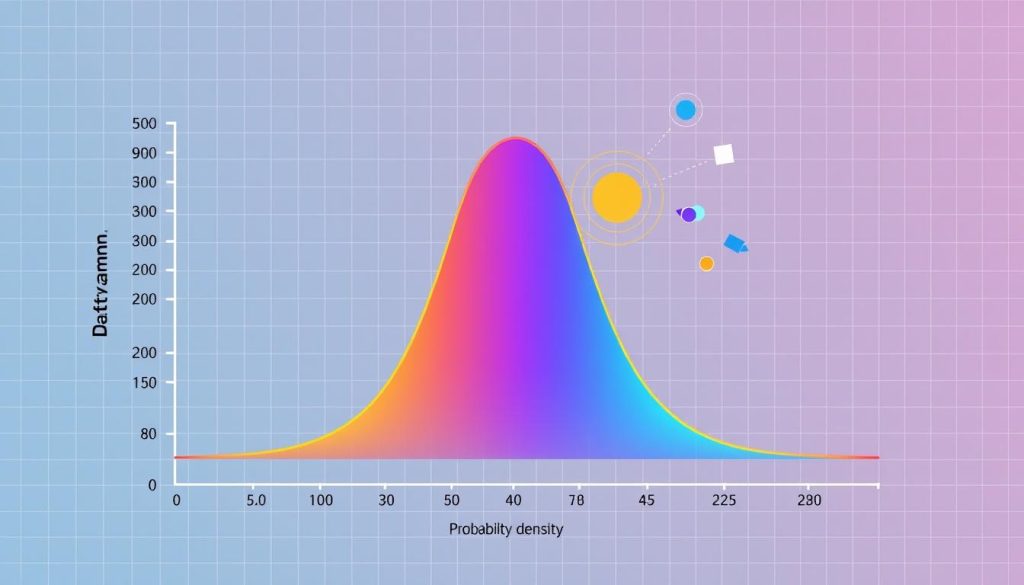
The kinetic theory of gases introduces the Maxwell-Boltzmann distribution. It shows how gas particles move. Most particles move at moderate speeds, while a few move very fast or slow.
The Maxwell-Boltzmann distribution is shaped by temperature and particle mass. It helps us understand gas behavior. This distribution is key to explaining gas phenomena like diffusion and chemical reactions.
Implications of the Velocity Distribution
The Maxwell-Boltzmann distribution of gas particle velocities has several key implications:
- The distribution is asymmetric about the most probable speed, with a longer tail towards higher speeds.
- The root mean square speed of an ideal gas depends on its type, whether monoatomic, diatomic, or polyatomic.
- The area under the Maxwell distribution curve represents the total number of molecules in collision.
- As temperature increases, the fraction of molecules having a speed equal to the most probable speed decreases.
- The speed distribution also depends on the mass of the molecules along with the temperature.
The Maxwell-Boltzmann distribution of gas particle velocities is a fundamental concept in the kinetic theory of gases. It gives us insights into the complex behavior of these particles and their interactions.
| Parameter | Vessel A | Vessel B |
|---|---|---|
| Most Probable Speed | 500 m/s | 707 m/s |
| Root Mean Square Speed | 577 m/s | 816 m/s |
| Ratio of Most Probable to Root Mean Square Speed | 0.87 | 0.87 |
Gas Viscosity and Diffusion
The kinetic theory of gases helps us understand how gases move and interact. It explains gas viscosity and gas diffusion. These are key in many fields, like fluid dynamics and chemical reactions.
Gas Viscosity: Viscosity shows how hard it is for a gas to flow. It depends on how gas particles move and hit each other. For instance, water is much thicker than air, showing how different gases can be.
Gas Diffusion: Diffusion happens when gas particles move and mix randomly. The kinetic theory shows how this movement affects gases. It’s important for understanding how gases spread out.
| Property | Water at 20°C | Air at 20°C |
|---|---|---|
| Viscosity | 1.0 × 10⁻³ Pa · s | 1.8 × 10⁻⁵ Pa · s |
| Thermal Conductivity | 0.60 W/m · K | 2.5 × 10⁻² W/m · K |
The table shows big differences in gas viscosity and thermal conductivity between liquids and gases. It shows why knowing these properties is so important.

Applications of Kinetic Theory of Gases
The kinetic theory of gases has many uses in different fields. It shows how important it is for science and technology to grow.
Engineering and Industry
In engineering and industry, the kinetic theory helps a lot. It helps understand gas behavior in important processes like combustion and refrigeration. Engineers use it to make these processes better and more efficient.
Chemistry and Chemical Processes
The kinetic theory gives chemists key insights. It helps them understand chemical reactions and gas behavior in catalytic processes. This knowledge helps them improve chemical reactions and study gas molecule interactions.
Astrophysics and Atmospheric Science
In astrophysics and atmospheric science, the kinetic theory is used too. It helps scientists study gas behavior in atmospheres and stars. This knowledge helps them understand the universe better.
Biological and Medical Research
The kinetic theory also helps in biology and medicine. It helps understand how gases like oxygen move in our bodies. This is important for studying breathing and finding new treatments.
The kinetic theory is key for science and technology progress. It helps in many areas, from engineering to biology. As we learn more about gases, the kinetic theory will help us discover even more.
Experimental Verification and Limitations
The kinetic theory of gases has been tested through many experiments. These experiments have shown that the theory is right about gas pressure, temperature, and volume. They also confirm the theory’s predictions about gas particle velocities.
 The Periodic Table: Structure, History, and Elements
 But, the kinetic theory makes some assumptions that don’t always hold true. Real gases don’t always act like the theory says they should. This is because gas particles are not points and they interact with each other. These interactions can cause problems at high pressures or low temperatures.
Deviations from Ideal Gas Behavior
Real gases don’t always follow the ideal gas laws. Scientists are working to understand these differences and create better models. Some reasons for these differences include:
- Finite particle size: The theory assumes particles are points, but real particles have size.
- Intermolecular forces: The forces between particles can affect their behavior, especially at high pressures or low temperatures.
- Molecular interactions: The way particles interact and collide is more complex than the theory suggests.
Research is ongoing to improve our understanding of gas behavior. By studying these differences, scientists aim to create more accurate theories. This will help predict and describe how real gases behave in various situations.
| Experimental Parameter | Ideal Gas Behavior | Observed Deviations |
|---|---|---|
| Pressure | Linear relationship with temperature | Non-linear relationship at high pressures |
| Volume | Inversely proportional to pressure | Deviations from inverse proportionality at high pressures |
| Compressibility | Constant (equal to 1) | Variations in compressibility at high pressures and low temperatures |

Kinetic Theory of Gases in Real-World Scenarios
The kinetic theory of gases helps us understand gas behavior in many real-world situations. It’s used in many industries and scientific fields. This leads to new discoveries and improvements.
Industrial Processes
In industry, this theory guides the design of important equipment like compressors and turbines. It helps engineers make these systems more efficient. This means better performance and lower costs.
Atmospheric Science
In atmospheric science, the kinetic theory is key. It helps scientists study how gases move in our atmosphere. This knowledge is vital for better weather forecasts and protecting our environment.
Astrophysics
The kinetic theory also helps us understand gas behavior in space. It’s used to study gases in stars, planets, and between stars. This knowledge helps us learn more about the universe.
Thanks to the kinetic theory, we’ve made many new technologies. It keeps helping us discover new things in science and engineering. As we learn more, we’ll see even more amazing discoveries.
| Application Area | Key Insights from Kinetic Theory | Examples of Real-World Impact |
|---|---|---|
| Industrial Processes | Understanding gas behavior, optimizing equipment design | Improved efficiency in compressors, turbines, and heat exchangers |
| Atmospheric Science | Modeling gas transport, cloud formation, weather dynamics | Enhanced weather forecasting, environmental protection strategies |
| Astrophysics | Studying gas properties in stellar environments, planetary atmospheres | Advancing our understanding of the universe |
Historical Development and Pioneers
The kinetic theory of gases has a rich history. Many scientists contributed to our understanding of gas behavior models. From Daniel Bernoulli and Rudolf Clausius to James Clerk Maxwell and Ludwig Boltzmann, their work shows the power of science.
Daniel Bernoulli, a Swiss scientist, was one of the first to suggest gas particles move randomly. Rudolf Clausius, a German physicist, later explained how these particles interact.
James Clerk Maxwell and Ludwig Boltzmann built on these ideas. They found the statistical distribution of gas particle velocities, known as the Maxwell-Boltzmann distribution. This discovery is key to understanding the kinetic theory history and gas behavior models.
Other important figures include Amedeo Avogadro, who introduced Avogadro’s number, and John Dalton and Émile Clapeyron, who helped create the ideal gas laws.
The kinetic theory has grown thanks to these pioneers and others. Their work is a foundation of our knowledge of the physical world. It continues to inspire research in physics, chemistry, and more.

Advancements and Modern Research
The kinetic theory of gases is still a hot topic in modern research and advancements. Scientists are working hard to make the theory work for more complex gas behaviors. This includes understanding strong intermolecular forces, non-equilibrium conditions, and how gases react to external fields.
New tools and techniques in computing have helped create better kinetic theory advancements models. These models can now accurately predict how gases behave in many different situations. They are crucial for improving the performance of technologies and processes that involve gases.
Emerging Areas and Future Prospects
New areas of research in the kinetic theory of gases include studying nanoscale gas systems and quantum gases. It also involves looking at how gases interact with solid surfaces. As technology and our understanding grow, the kinetic theory will play a bigger role in science and innovation. This includes fields like energy, materials science, and aerospace engineering.
The future prospects for the kinetic theory of gases look very promising. Scientists will keep exploring and finding new uses for this key scientific idea. With better computing and simulation tools, the kinetic theory will help us better understand and control gas behavior in many areas.

Kinetic Theory of Gases: Visualization and Simulations
The kinetic theory of gases is perfect for visual and computational models. Molecular dynamics simulations show how gas particles move and collide. This helps us understand the kinetic theory better.
These simulations let researchers study gases under different conditions. They can see how factors like size and mass affect gas behavior.
Computational models based on the kinetic theory have gotten better. They can predict gas properties and improve industrial processes. Seeing gas behavior at the molecular level has helped us learn more about the kinetic theory.
For example, studies on cavity-strut flame holders used high-speed cameras and CFD. They showed how the design improves fuel atomization and flame stability. Adding spheno-lugs and triangle-lugs to struts also improved outlet temperatures.
These visual and computational tools are key to understanding gas particle interactions. They help us grasp the complex dynamics in TBCC engines and cavity flame holders.
 Law of Mass Action: Fundamentals of Chemistry


